St Nicholas Village for Orphans opening

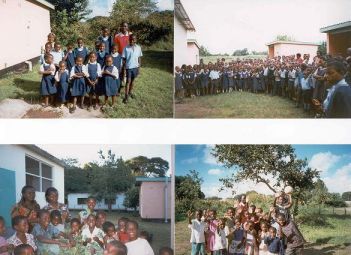
The Blessing Ceremony of the AIDS Orphan Village took place on January 17th, 2001. There were many children present for the occasion, as you can see. It has been decided to call the AIDS Orphanage Village after St Nicholas, the Patron Saint for Orphans. Fourteen little buildings were blessed, i.e. ten residences for orphans, the kitchen/storeroom, the common/dining/recreation room and the Tuck Shop, which is a continuous fund-raising project for the Orphanage.

Thanks to the amazing generosity of donors, we have been able to pay off the debt of K85 million on buildings, K17 million on the dining room, K22 million on furniture and equipment.

As of January 23rd, 2002, thirteen children had been identified for adoption and inclusion in the project, ranging in age from a girl of 12 (one half of a twin; the other was sold into marriage — see what happens when there is no one to take care of these little ones?) to a baby. The legal processes are under way and we hope soon to be able to send you e-mail photographs of the children in residence. Three staff have been engaged to run the project, that is Mrs Judy Passmore (Day Housemother), Miss Grace Phiri (Night Housemother), and Mr Alfred Mulenga (Gardener/maintenance worker/to be trained also as driver)

Posted in St Nicholas Orphanage | Tagged , | Leave a comment

30th graduation ceremony

Herewith a nice report from Mrs Allen about the Graduation Ceremony held for our adult students on September 7th, which occasion was also used to celebrate the 30th anniversary of the founding of the Centre.

The 30th Graduation Ceremony held on 7th September 2001 was a very happy and colourful occasion. There were 70 graduates: 15 from the Home Economics Department, 12 from the Agriculture General Department, 26 from the Agriculture Settlement Department and 17 from the Electronics Department.

Towards the middle of the year the students decided to organise graduation gowns. The Executive Committee members suggested that the graduation gowns be introduced next year since there was very little time to organise the sewing of the gowns. They were adamant. A committee of three lecturers and two representatives from the Home Economics, Agriculture General and Settlement was formed. The result was that all graduating students had gowns — different, of course, according to the groups. The Home Economics students had black skirts, green blouses and black shawls. The settlement students wore chitenge costumes and the agriculture and electronics students had the gown, hood and cap.

The organising committee requested that the ceremony be held outside in the quadrangle. I pointed out that it is usually hot by 11.00 hrs. ” No problem,” came the reply. “One female student is married to an army officer and he will provide three large tents.” Free of charge, transport and workers provided! If MEC management had tried to organise the tents I am certain that we would not have managed. I asked whether maintenance workers should assist in carrying the chairs from the Commonwealth Hall. That was not necessary either. I thought to myself tomorrow will be a disaster. The tents were erected the day before; that is 6th September. On the 7th September, the male students arranged the chairs and tables, the female students arranged the flowers (roses bought by the organising committee!) In no time the place was transformed.

The guest of honour, Dr Nkanza, Director General of the Technical Education Vocational Entrepreneurship Training Authority (TEVETA) arrived shortly before 10.00hrs accompanied by the Director Finance and Administration, Mr Nataraaj. At 10.15 hrs the ceremony started. All the graduating students were crowded in the Grade 3 and 4 classroom opposite the open space. When the music started, they came out dancing led by one lecturer. It was a beautiful sight. Since this was a surprise we did not organise a video. Friends and relatives were invited to the ceremony. Marketeers opposite the centre and passers-by came to see what the loud music was all about. There was a large crowd. Speeches were made and certificates and diplomas were presented.

It turned out that the reason why the graduation ceremony was held outside was that the Commonwealth Hall had been prepared for an end of the year party. After the graduation ceremony, parents, friends, relatives, invited guests and members of MEC staff were invited to the party. I was not told how much each student contributed, but there was plenty of food and soft drinks. The leftovers were taken to the orphanage.

It turned out to be a very pleasant 30th Anniversary celebration, all organised by the students and members of staff from the Adult Education department.. MEC did not spend a single ngwee towards it. I think this was a wonderful gift from the students and staff, thanking MEC for the thirty years of its existence. Unfortunately Fr Dil and Mrs Dil arrived the day after. The tents had been removed and all the excitement had died down. We had nothing to show for it except a few photographs of the event!

Christine Allen

Posted in Adult education, Departments | Tagged , | Leave a comment

Orphanages are necessary in Zambia

Report by Revd Andrew Mukuyamba

African society has for a long time been perceived as a community that takes care of its underprivileged, especially orphans. This perception was correct until the late 1980s, when families could no longer cope with the ever increasing numbers of destitute people. Recently we have seen a dramatic increase in the number of orphans in Zambia due to HIV/AIDS. The statistics are readily available for those interested in them. But statistics are boring — a short case history tells the story better:

In 1993, I came across an elderly lady whose three children had died, leaving her with seven grandchildren to look after. This lady is divorced and has no source of income apart from selling mangoes, other fruits and sometimes roasted groundnuts near a beer hall. She uses the children to sell these items most times, and as a result the children do not attend school. They wake up early in the morning everyday and go to bed late. They spend all their time sitting near this beer hall selling the merchandise. They have to work hard for their food and if possible their clothing. It is like slavery, being an orphan in Africa today. The problem is growing. Everyday more children are orphaned. Many adults are dying of AIDS, leaving small children unable to support themselves or to receive help from relatives. Extended families have no means of sustaining them. With only 180,000 formal employment jobs in a population of 12 million people, the economic situation does not allow them to take extra dependants into their homes.

Nevertheless there is a feeling in some quarters abroad that the orphan problem has no impact on African society because orphans can be looked after by relatives and the best orphan care programme is one in which members of the family are involved. This is false, especially in Zambia today. People who live in the community are always narrating how orphans suffer at the hands of relatives, most of whom have no means to feed extra mouths and are cruel to orphans and do not care about their well-being and future. It is projected that by the year 2010 there will be 1.01 million orphans in Zambia (a very low estimate). Which family will have the capacity to care for them given the current scenario?

In the average family, much money is spent on taking the sick to hospital and, if such people die, the family spends a lot more money on funeral arrangements and burial. In the end the remaining family has no capacity to look after orphans. It is, therefore, not true that the orphan problem can be solved in the family, by the family, or by organisations working with families in a family set-up. Orphans in a family are usually ill-treated and receive little or no food and clothing, and may not even get the minimal education they need for their future. It is only natural that in a situation of poverty, parents put their own children first and any orphans in that family last.

Regrettably, there is now a great need for institutionalised orphan-care programme in Zambia. In view of the strong family focus of Zambian society such orphanages will always be run as much like a family as possible. Non-governmental organisations that are trying hard to set up such care programmes must be encouraged and supported financially, materially, morally and spiritually.

In Zambia we definitely need support to set up good orphanages if we are to give these orphans a chance in life, keep them off the streets and have them grow up in a loving, caring environment.
Posted in HIV and AIDs, St Nicholas Orphanage | Tagged , , | Leave a comment