Makeni Street

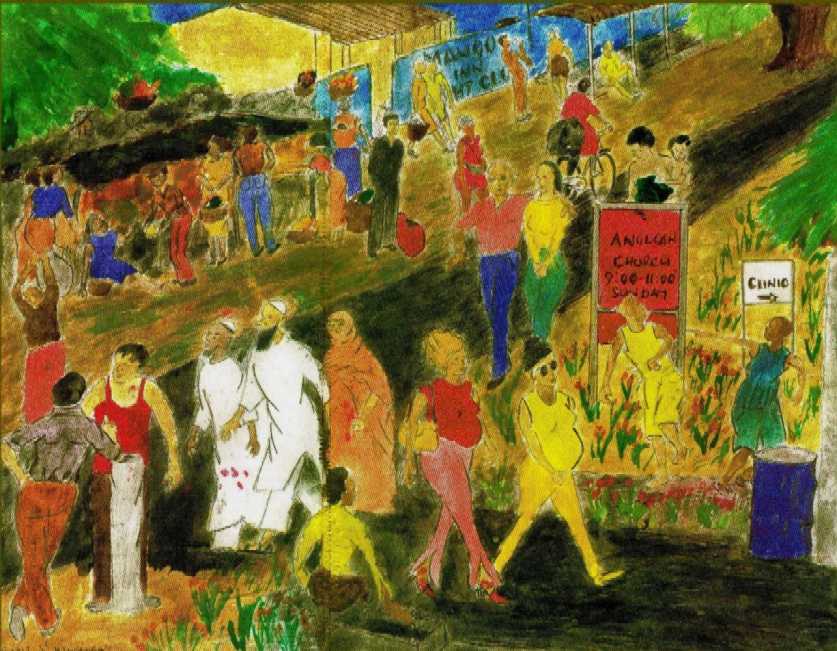
Venus Mwanza has kindly given us permission to reproduce his painting of Makeni Road, outside the grounds of MEC. This painting was published by BBC Focus on Africa Magazine in 2003, winning Venus (former student and current employee of MEC) a nice prize, as well as local recognition and a number of commissions!

An impression of Makeni Road by Venus Mwanza

Makeni Street

It feels like MEC has been a magnet for activity over the years. Then again, Makeni is just not the rural area it used to be. Now we have a few local shops, a market (which probably was due to MEC’s location), occasional bus services. There is also a Catholic church and mosque nearby.

Notice the signs pointing to the Anglican Church and clinic inside the grounds!

Venus reflects on the cultural and religious diversity of the community represented on our road and concludes: “somehow everyone manages to respect one another.”

Posted in General news, The way we were.... | Tagged , , | Leave a comment

The childrens’ stories

How the children came to be at St Nicholas

Patrick and Elizabeth are brother and sister. Their father was an electrician working for ZESCO power company. Following the death of their parents, an aunt brought Elizabeth to us and kept Patrick at her home. Elizabeth was always talking about her brother; how she missed and worried about him. Convinced the two should not be separated, Mrs. Passmore talked to the aunt to see about bringing Patrick to the orphanage. She was happy for him to come here. Patrick and Elizabeth are visited by their aunt about once a year.

Jane and Gift are brother and sister. Their parents were staying in the hospice in Chilanga while sick with AIDS. Before his death, the father told the nuns working there to take care of his children. Following the death of both parents, the children stayed at the hospice. They could not stay there very long and were brought to St Nicholas’ Orphanage. During her brief stay at the hospice, Jane had become quite attached to some of the nuns and when she was dropped off she was crying. Since then, though, she has found a happy home here. The orphanage had no contact with any of the children’s relatives until one day when a young woman came by claiming to be the children’s sister and they confirmed this to be true. Gift is very clever and Jane loves to draw pictures.

Maybin came to us as a 9 month old baby. He was driven here by the ambulance carrying his mother, who was dying from AIDS. His father had died before he was born. Two months after Maybin’s arrival his mother died. He started attending nursery school and was doing well. His grandmother used to visit Maybin, until one time when she asked to take him away with her. Mrs. Passmore knew about the grandmother’s situation and decided it would not be good for Maybin to stay with her. The grandmother has not returned to visit since then.

Chipo, Emmanuel, Eunice, Esther and Mofatt are siblings. Emmanuel and Eunice are twins. All of them except Mofatt were staying with their grandmother after their parents died. The grandmother, despite being a very old lady, was taking care of four other children besides them. The children were attending school up until the death of their parents, after which none were able to because the grandmother could not afford it. The grandmother brought Chipo, Emmanuel, Eunice and Esther first. Later, their brother Mofatt was left here by some relatives he had been staying with. They have an older sister (14) who is not at the orphanage because she is married and has a child. Eunice is very bright and is top of her class. This older sister is an example of a common problem: Teenage orphan girls who are not cared for will seek a husband as a means of gaining support.

Sarah is not staying here at the orphanage and never has. She is a young girl living with her aunt doing household chores, and taking care of her aunt’s baby. Her aunt is rarely even at home. Mrs. Passmore visited this home and found the aunt lying down ordering Sarah around. Outside, the baby was lying in the rain, sleeping. Mrs. Passmore advised Sarah to take the baby inside, but she said she didn’t want to, because the baby might start crying. Mrs. Passmore has tried desperately to convince the aunt that Sarah should go to the orphanage, but the aunt refuses.

Edinah is a name that cannot be said without a smile appearing on one’s face. She is – how can one put it? – especially energetic. She is a girl who begs enthusiastically to read a book with her tutor and then while doing so rocks in her chair, chews on a pen, glances out the window almost every minute, and secretly nibbles on a fritter which she is not supposed to have at breakfast. She had been staying with her auntie, but Father Banda could see it was not a good situation and brought her to the orphanage. We know very little about Edinah’s family, nobody has ever come to visit her.

Sandra was brought to our attention by Bishop Mumba’s wife. After her father died, her mother re-married. The new husband did not want to keep Sandra and so she was sent to live with her grandmother. Her grandmother lived on a farm and Sandra had to do chores like fetching water from a distant pump and collecting firewood. She stopped going to school during this time. When she came to the orphanage she only had the clothes on her back and no shoes. Since her arrival Sandra has only been visited twice by her grandmother. The grandmother says it is too far for her sore legs. Sandra is visited about once a year by her mother.

Ruth, Ester and Idah are sisters. Mrs Passmore was told about this family and decided to visit. She found the house very crowded; aunties, uncles, grandmother, older brother (12), plus the three sisters all living together. After the death of their parents the sisters could no longer attend school because of finances. The grandmother was happy for Ruth, Ester and Idah to come to St. Nicholas orphanage. She believes it is very important for children to get an education.

Tendai and Chipo are twin sisters. Following the death of their parents Chipo went to stay with her auntie. She continued to go to school, but her auntie had so many other children to take care of, so Chipo came to Makeni. Meanwhile her sister had gone to live with her uncle on a farm in a remote area. Tendai had never been to school until she came to the Makeni orphanage at the age of 13. She began with grade 3. She found it embarrassing sitting in the classroom, but she pushed on. She received tutoring from Mrs Allen and, despite failing grade 3 the first time, she is now in grade 6 and is a determined student. Tendai is very friendly and loves reading.

Audrey, Bertha and Wisdom are siblings. Their father was a policeman and died when Wisdom was 8, Audrey 11 and Bertha 13. Their mother was a business woman, buying wholesale and selling at an open-air market. She died shortly after the father. These children came from a good home: nice, big house, TV. They would occasionally go for a family picnic at Munda Wanga Gardens. After their parents died, the children stopped attending school and went to stay with their grandparents on a farm. They have a big family, but since the children came to Makeni no one has come to visit them. When Wisdom grows up he wants to be President of Zambia! His sister Audrey has an artistic side.

Abigail was found living out on a farm. Even though she was very small she had to fetch water. After coming to Makeni, the staff noticed that every now and then she would fall without tripping on anything. Other times she would have fits and shake. She was taken to the University Teaching Hospital where she was diagnosed with epilepsy. She is now taking pills daily and doing much better. Occasionally she has times when she seems argumentative and unfriendly, but Mrs. Passmore has explained to her classmates and teachers about her condition.

Following the death of both of his parents, James lived briefly with his grandparents and then came to Makeni at the age of 8. Initially, James was timid and never used to play or even smile; he was very withdrawn. Mrs. Passmore took him to see a psychiatrist, where he got a prescription for more love. Now he is doing much better; it is like night and day. He smiles, plays with friends, and is a good reader. He is very seldom visited, but is distantly related to one of the nannies, Mary.

Peter remained at home after his sister was placed in Makeni orphanage. His grandmother was taking care of multiple orphaned children and working full time at the market across from Makeni Centre. Peter was not attending school and was roaming the streets playing with friends all day. Later he was united with his sister at the orphanage.

Daniel was seven when his father died in 1995 of ”Malaria” (actually, more likely AIDS). His mother sold fruits and vegetables at the local market. His mother died in 2000, and Daniel was taken care of by his auntie. He stopped going to school for about a month because his auntie could not afford the fees. Then he came to the Makeni orphanage in 2001 and continued school. He has three older brothers who live in Chawama. He is visited by them quite frequently. His favourite subject in school is geography, and if he could visit any country in the world it would be Germany. His passion in life is football, his favourite team is Arsenal and when he grows up he wants to be a professional football player, or failing that, an engineer.

Evelyn was one of the first to arrive at St Nicholas orphanage. She was 8 when her mother died. Her father, who was a policeman, died 2 years later. After this she lived in Mwombeshi with her older sister who was in her 30s at the time. Her sister could not afford school fees, so Evelyn was brought to the orphanage. She is visited about five times a year by family. She is now in grade 9 and doing well. She plans to finish school, and then begin training as an accountant (she likes maths). Evylen enjoys playing volleyball for fun.

Posted in St Nicholas Orphanage | Tagged , , | Leave a comment

Orphanage news

A report by the orphanage staff and Mrs Catherine Oreta

Jan and Truus Veldkamp recently funded the improvement of the play park, which they also originally set up. This is a heavily used and much enjoyed facility for all children who spend time at the centre.

In addition, Jan and Truus have purchased a music centre for the orphanage and a television. Together with a donated video recorder the children now have a good range of entertainment facilities. Access is rationed!

The nearly 40 children in the Village are growing up very fast and they are doing generally very well.

The children are doing very well in school, Esther Chisenga was again top of her class.

We are very happy we bought a big new pot and new washing line on which we can hang all our washing.

We had, as has now become usual, a party on St Nicholas Day. It was a very happy occasion with the children singing Zambian/Dutch St Nicholas songs at the tops of their voices!

A friend of Makeni Ecumenical Centre, Mrs. Dodd, offered to make all the preparations for Christmas presents for each child this last Christmas. Children of members of staff living within the Centre were also invited to the Christmas Party. House mother, Mrs Passmore, was Mother Christmas. She was also asked to be Mother Christmas at the end of the year parties for the whole primary school!

A positive development in this project is the introduction of the HEPS ( High Energy Protein Supply) food supplements. We approached an agency, Project Concern International, for HEPS and soya cooking oil donations and we are happy to report that these are now being received regularly. The Orphanage staff were taught how to prepare the food. The children are now eating the soya porridge every morning instead of mealie meal porridge. Happily, there will be a constant supply of HEPS, soya cooking oil and maize grain or whole wheat from now on. The expenditure for food has gone down considerably and the children’s health has improved a lot.

Closely connected with the orphanage is the Home Based Project, supporting orphans outside of the centre. We support 12 children with school fees, 4 at Secondary School and 8 at Primary School. We also supply a bag of mealie meal every month to 8 families. The requests for support are very high.

AAA Support

We have received another donation of CS$2000 from the Afirica AIDS angel project in Victoria, including a private donation of CCS$500 by a recently unemployed couple, which will partly go towards the orphanage and partly towards other deserving MEC projects in the fight against AIDS. We are very grateful to our friends in Canada for their continued and generous support.

Other friends recently sent a number of boxes with gifts, including teddy bears for the children. The Housemother, Judy Passmore, reported:

“The children were delighted with them and would not be parted from them. They slept with them. The next morning when I came to the Home, I found all the children clinging to their teddies. We have not yet decided to whom to give the rest of the teddies in the community. Say thank you also to your group ‘AIDS Angels of Africa’ for all the good and hard work and the money that they donated. Your ladies and donors are great. All the clothes are nice to wear – skirts, T-shirts, trousers, dresses, warm clothes and then football shirts. We all, even me, put on a football jersey. Thank you also for the medicines! You are so good. May you continue to work for what is good. Giving is a gift from God. Read, Roman’s 12: 6-8, Acts 22: 3-7, Corinthians 9:6 and Galatians 6:10. Thank you also for the toys and books I pray that our wonderful God will continue blessing you.”

The children themselves wrote:

Greetings in the wonderful name of our Lord and Saviour Jesus Christ. We hope God is richly blessing you. Here we are all fine. We children of St Nicholas Orphanage would like to express our hearty felt gratitude to you for the various gifts such as clothes, teddies, books, toys and many more that we received. Each one of is really overwhelmed by these special gifts. We even took photographs while having them unpacked from the boxes and receiving them per child. The toys are beautiful and very colourful. We have never seen so many toys in our lives. What can we say? The young boys, Maybin and Christopher, played and played with the cars. They could not even put them down. We have already been told by ambuya and the aunties not to leave toys all over the place but to put them back in boxes. The girls also had some soccer jerseys given to them. We shall use them when playing other games like net ball. Yours Sincerely, Bertha Kabwe, on behalf of my brothers and sisters in Christ at St Nicholas.

Posted in St Nicholas Orphanage, Supporters | Tagged , , | Leave a comment

Daily life at St Nicholas

Report by Orphanage staff and Mrs Catherine Oreta

There are 33 orphans (eleven of which are boys) being kept at St Nicholas’ Village, all of whose parents died of AIDS related diseases. The children’s ages range from 15 years to 11 months.

The activities at the orphanage are run like in a home set-up with the help of four workers: three females and one male. The three female workers play the role of the mother, aunt and grandmother, while the male worker plays the role of uncle and father.

Mrs Judy Passmore plays the role of a grandmother and mother. She is the Orphanage Supervisor. She reports for work every morning at 07:30 hrs and knocks of at 17:00 hrs. She also attends to the sick children, taking them to hospital, like in the case of Mutinta who is always sickly, and ensuring that necessary medication is obtained, and visiting the sick children like in the case of the late Mirriam Tembo who died in hospital. She also ensures the school requirements are in place. She receives orphanage visitors and co-ordinates between the orphanage and the main office, mends clothes and sews new ones if there is material.

Mary Chininga and Grace Phiri play the role of mother and aunt. They live within the orphanage with the children.

Activities at the orphanage start as early as 05:00 hrs when everyone wakes up to start the day with prayers led by Grace Phiri and then go to assigned duties on the rota. Porridge preparation is done right away for the children’s breakfast. The children who go to school in the morning session are also prepared so that they can have their breakfast early enough. Cleaning and tidying of the dormitories, washing and ironing is done right away too with the help of the older orphan girls. Buns for the Tea Break are then prepared with the help of the older orphan girls at 10:00 hrs.

Lunch preparation starts around 10:00 hrs. The other children reporting to school in the afternoon session are also prepared so that they are not late. Lunch is served at 13:00 hrs

The children’s meals may include nshima, vegetables, beef, chicken, beans, eggs, tea, buns and milk.

In the afternoon, preparations for the evening meal start. The children are helped with homework and bathed. All this is done with the help of the big orphan girls.

The children go to sleep at around 20:00 hours after their evening prayers led by Grace Phiri.

Mr. Alfred Mulenga, who plays the role of an uncle and father, also helps with the maintenance. He keeps the outside surrounding tidy, planting and watering the flowers with the help of both girl and boy orphans. He also helps the children with their homework. He stays within the Centre but not at the Orphanage. He reports for work at 07:00hrs and knocks of at 17:00 hrs. The two Dutch volunteer girls, Mary Rose and Karen, and Mr Sandy Adam, another volunteer, help the children who have problems with school work with additional tuition.

Most children are involved in some working activity as a way of imparting knowledge and responsibility on them for their own future.

The children are generally happy although many of them have suffered serious trauma. The group is like a large family with the adults and children having a loving relationship. The older girls compete over who will carry the babies on their backs.

There is a great lack of toys, books, and simple sports articles, and the children are sometimes a little bored. A television set and VCR and children’s entertainment and educational video tapes would be a most welcome addition to their daily lives.

You can read some of the latest news in the village here.

Posted in St Nicholas Orphanage | Tagged , | Leave a comment